EPA 608 certification exam preparation
EPA 608 certification is a federal requirement. Without it you cannot buy refrigerant or service refrigeration and air conditioning equipment in the United States. It is not optional and it does not expire: you earn it once and it lasts your entire working life.
This program prepares you to pass that exam, in English, with the regulations updated through 2026.
Who it is for
For the technician who already works in HVAC and needs the certification. If you already know how to install, repair and service equipment, but you are missing the credential the law requires, this course is for you.
If you are starting from zero, the HVAC Technician Combo is a better fit: it covers the whole trade plus this certification.
What is included
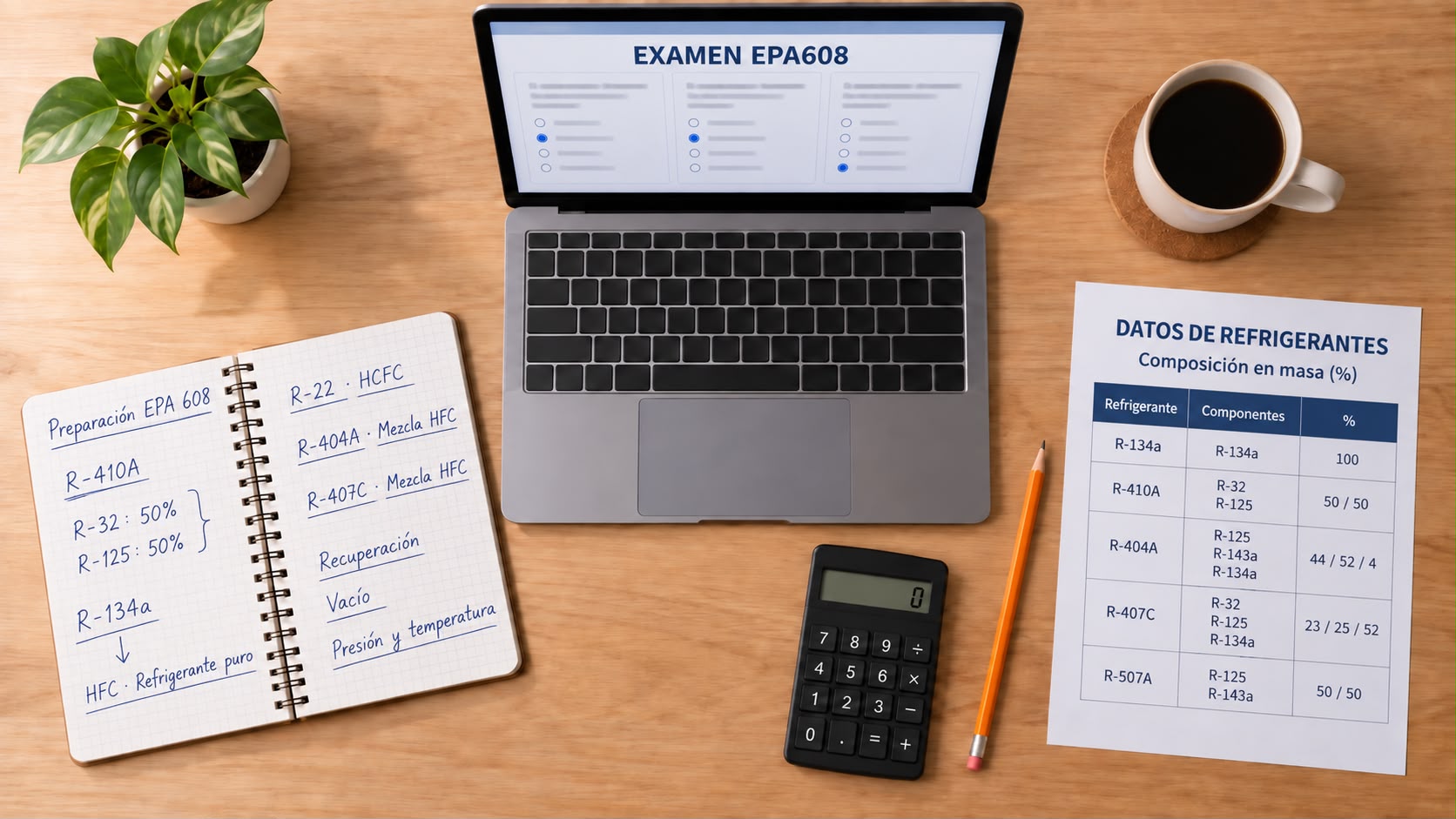
- Nine modules covering the four sections of the exam: Core, Type I, Type II and Type III.
- 95 lessons with the tables, figures and deadlines the exam asks about.
- A quiz at the end of every module, with the reasoning behind each answer.
- Four practice tests in the real exam format: 25 questions per section.
- A 100-question final exam, the full dress rehearsal for Universal certification.
- A bilingual glossary in every module, so the exam vocabulary is clear in both English and Spanish.
- An appendix on the AIM Act and A2L refrigerants, the material older manuals do not cover.
- Registration and the first attempt at the EPA 608 certification exam, coordinated by us with the authorized provider. Additional attempts cost $59.99 each.
Updated to current regulations
Between 2023 and 2026 the EPA issued three new rules that changed how refrigerants are handled in the United States. This program includes them, verified against the Code of Federal Regulations and the EPA’s own official publications.
How you study
One hundred percent online, from any state, with no schedules and no start dates. Move at your own pace and repeat the lessons as many times as you need. Twelve months of access.
About the exam
The EPA 608 certification exam is administered by an independent certifying organization approved by the EPA and carries a separate fee for each attempt. Learning Trade Center of Florida prepares you academically and coordinates your registration. The exam is taken on a computer; phones and tablets are not allowed. It is available in both English and Spanish.
Once you pass the exam, EPA 608 certification is issued and mailed to you by an independent certifying organization approved by the EPA, not by Learning Trade Center of Florida. That certification is the document you obtain with this program: no separate Learning Trade Center of Florida certificate of completion is issued here.
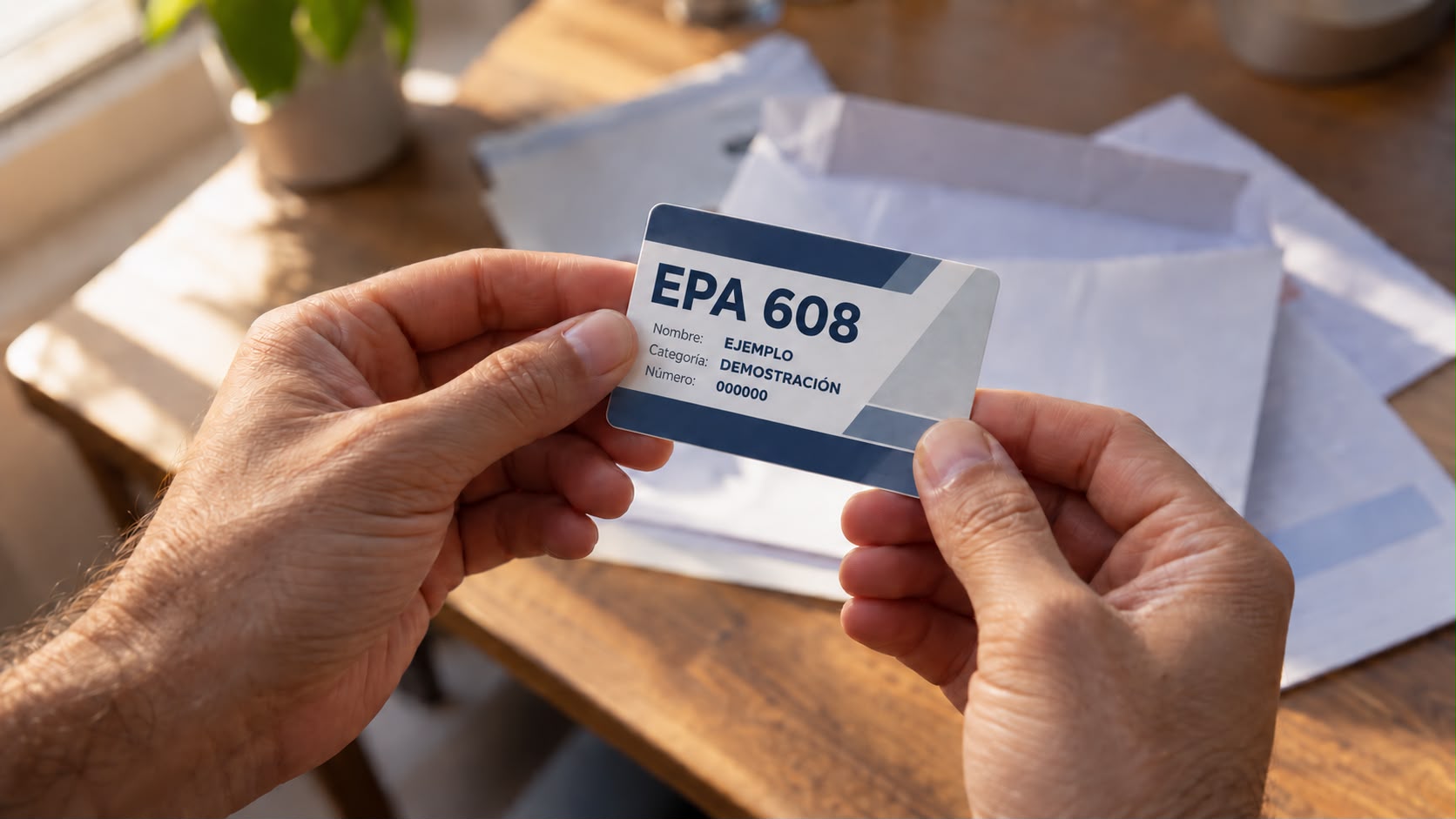
This Learning Trade Center of Florida program is academic preparation and does not award a certificate of completion of its own. EPA 608 certification is granted by an independent certifying organization approved by the EPA once you pass the exam; it is not a state license and it is not a certification issued by Learning Trade Center of Florida.
Módulos
MODULE 1 — Exam fundamentals and strategy
Lecciones
- Lesson 1.1 — What EPA 608 certification is and who it applies to
- Lesson 1.2 — The four certifications
- Lesson 1.3 — The real exam format
- Lesson 1.4 — What the 608 does not cover
- Lesson 1.5 — The regulatory map in 2026
- Lesson 1.6 — Buying refrigerant: the sales restriction
- Lesson 1.7 — How and where to take the exam
- Lesson 1.8 — Test-taking strategy
- Lesson 1.9 — Module 1 bilingual glossary
- Module 1 Quiz
MODULE 2 — Core A: science, refrigerants and oils
Lecciones
- Lesson 2.1 — The stratosphere and the ozone layer
- Lesson 2.2 — How chlorine destroys ozone
- Lesson 2.3 — Effects of ozone depletion
- Lesson 2.4 — ODP: ozone depletion potential
- Lesson 2.5 — GWP: global warming potential
- Lesson 2.6 — The refrigerant families
- Lesson 2.7 — How to read the R number
- Lesson 2.8 — Blends: azeotropic, near-azeotropic and zeotropic
- Lesson 2.9 — Glide, bubble point and dew point
- Lesson 2.10 — Fractionation and liquid charging
- Lesson 2.11 — The oils
- Lesson 2.12 — ASHRAE 34 safety and cylinder marking
- Lesson 2.13 — Module 2 bilingual glossary
- Module 2 Quiz
MODULE 3 — Core B: law and regulation
Lecciones
- Lesson 3.1 — The Clean Air Act and Section 608
- Lesson 3.2 — The Montreal Protocol
- Lesson 3.3 — The phaseout calendar
- Lesson 3.4 — The venting prohibition
- Lesson 3.5 — Exempt substitutes and the SNAP program
- Lesson 3.6 — The sales restriction in detail
- Lesson 3.7 — Leak repair under Section 608
- Lesson 3.8 — The AIM Act and the ER&R rule
- Lesson 3.9 — Technology Transitions and the GWP limits
- Lesson 3.10 — Records and reports
- Lesson 3.11 — Penalties and enforcement
- Lesson 3.12 — Reclamation, certified equipment and safe disposal
- Lesson 3.13 — Module 3 bilingual glossary
- Module 3 Quiz
MODULE 4 — Core C: practice, safety and transport
Lecciones
- Lesson 4.1 — The three Rs
- Lesson 4.2 — The two types of recovery equipment
- Lesson 4.3 — Equipment certification and the 1993 date
- Lesson 4.4 — Required evacuation levels
- Lesson 4.5 — Small appliances: 80 and 90 percent
- Lesson 4.6 — Exceptions to evacuation
- Lesson 4.7 — How to speed up recovery
- Lesson 4.8 — Do not mix refrigerants
- Lesson 4.9 — Dehydration and vacuum
- Lesson 4.10 — Recovery cylinders
- Lesson 4.11 — The 80 percent rule
- Lesson 4.12 — Disposable cylinders
- Lesson 4.13 — Nitrogen for leak testing
- Lesson 4.14 — Personal safety, machinery room and transport
- Lesson 4.15 — Module 4 bilingual glossary
- Module 4 Quiz
MODULE 5 — Type I: small appliances
Lecciones
- Lesson 5.1 — What legally counts as a small appliance
- Lesson 5.2 — What they look like inside
- Lesson 5.3 — Recovery requirements
- Lesson 5.4 — Recovery with a working compressor
- Lesson 5.5 — Recovery with an inoperative compressor
- Lesson 5.6 — Access valves and fittings
- Lesson 5.7 — Saturation point and the P/T chart
- Lesson 5.8 — Identifying refrigerant and detecting non-condensables
- Lesson 5.9 — Substitutes and acid in the system
- Lesson 5.10 — Type I safety
- Lesson 5.11 — Module 5 bilingual glossary
- Module 5 Quiz
MODULE 6 — Type II: high pressure
Lecciones
- Lesson 6.1 — What Type II covers
- Lesson 6.2 — Components and the state of the refrigerant
- Lesson 6.3 — Determining the system charge
- Lesson 6.4 — Signs of a leak in high-pressure systems
- Lesson 6.5 — Detection methods and instruments
- Lesson 6.6 — Pressure testing with nitrogen
- Lesson 6.7 — Leak repair applied to Type II
- Lesson 6.8 — Leak repair records
- Lesson 6.9 — Major and non-major repairs
- Lesson 6.10 — Evacuation in Type II
- Lesson 6.11 — Recovery techniques and cross-contamination
- Lesson 6.12 — Line accessories
- Lesson 6.13 — System evacuation and charging
- Lesson 6.14 — Type II safety
- Lesson 6.15 — Module 6 bilingual glossary
- Module 6 Quiz
MODULE 7 — Type III: low pressure
Lecciones
- Lesson 7.1 — What a low-pressure appliance is
- Lesson 7.2 — Inside the centrifugal chiller
- Lesson 7.3 — The purge unit
- Lesson 7.4 — Leak detection and the order of preference
- Lesson 7.5 — The maximum test pressure
- Lesson 7.6 — Leak repair in Type III
- Lesson 7.7 — Recovery on low-pressure appliances
- Lesson 7.8 — Evacuation, major and non-major repairs
- Lesson 7.9 — Recharging the chiller
- Lesson 7.10 — Oil and safety
- Lesson 7.11 — Module 7 bilingual glossary
- Module 7 Quiz
MODULE 8 — Appendices: the AIM Act and A2L refrigerants
Lecciones
MODULE 9 — Practice tests and final exam
Lecciones
- Lesson 9.1 — How to use the practice tests
- Practice Test 1 — Core Section
- Practice Test 2 — Type I Section
- Practice Test 3 — Type II Section
- Practice Test 4 — Type III Section
- Lesson 9.2 — The final exam
- Final Exam — Core Section
- Final Exam — Type I Section
- Final Exam — Type II Section
- Final Exam — Type III Section